The revealing part of Google’s Claude announcement is a four-row table. Both deployment options get new models on release day. Both use Google Cloud billing, with the same standard pricing. But one gets Anthropic’s new tools immediately; the other gets them “once integrated into the Google-managed infrastructure.” A model can arrive on time while the tools around it wait.
Anthropic announced its full platform on Google Cloud on October 22. In Google’s companion post, Michael Gerstenhaber, VP of product management for Gemini at Google Cloud, spells out the choice: Anthropic can run the service and process the data under its own commercial terms, or Google can do so under its existing customer agreements. I think the important concession here is Google’s willingness to sell access to a product whose release schedule Anthropic controls.
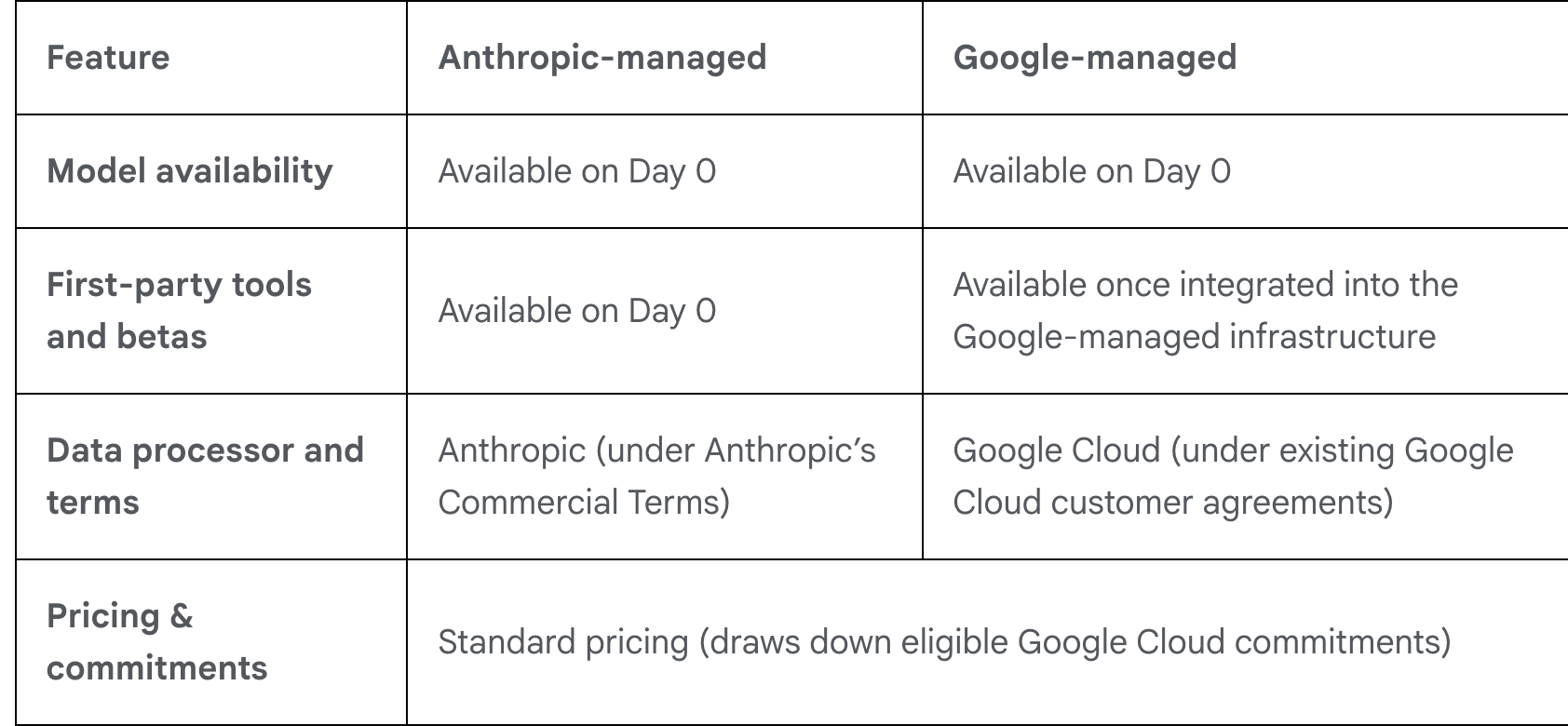
If you use Claude through Google Cloud, ask which deployment supplies it. The answer determines whether a newly announced agent feature reaches your application immediately or waits for Google’s integration work.
Day one
“Accessing new features on day one is important,” says Arvind Sundararajan, CTO of Abacus.AI, in Anthropic’s announcement. His company builds enterprise agents and assistants; he says existing Google Cloud permissions and spending commitments helped make the decision easy. I believe him. A builder waiting for a tool that competitors already have is waiting to ship part of a product.
The Anthropic-managed option includes Managed Agents in beta, code execution, computer use, agent skills, and the MCP connector in beta, which connects Claude to other tools. New platform features and betas arrive alongside their release on Anthropic’s own platform. Developers also get the Claude Console for configuring agents and monitoring their use and cost.
Fast Mode for Claude Opus 5.5 gives the announcement a concrete price: $8 per million input tokens and $40 per million output tokens.
Maksim Gorev, head of AI engineering at Triple Whale, makes a less glamorous point in the same announcement. His company’s ecommerce agent, Moby, relies on prompt caching to keep costs down, and he says the Google Cloud offering preserves it while moving billing and access through Google.
Google’s side of the choice
The Google-managed option brings a different set of advantages: BigQuery, Model Armor, and Agent Engine integrations; Google as the data processor; and controls including VPC Service Controls, customer-managed encryption keys, and stated residency options in the U.S., EU, and APAC. An enterprise already built around those services has a reason to choose it even while some Anthropic tools arrive later.
Google still supplies the infrastructure for the Anthropic-managed option, along with identity permissions, audit logging, and billing. Anthropic supplies the service and its terms. Google is making room for a second company’s development environment inside its commercial relationship with the customer.
The bargain gives each company something it wants. Anthropic reaches buyers through accounts and budgets they already use. Google keeps the infrastructure business and the purchasing connection, including eligible commitments to spend on its cloud.
AWS, Microsoft, and the discount trap
AWS launched Claude Platform on AWS on May 11. It offers Anthropic’s native API, console, and early-access features through an AWS account, with AWS identity credentials and consolidated billing. Anthropic operates this service. Amazon Bedrock is the separate AWS-operated option.
If you created a Claude Platform on AWS workspace before September 18, check where it processes and stores content. Anthropic’s docs say those older workspaces may use infrastructure elsewhere, while newer ones use AWS hardware for requests, inference, and storage. Anthropic processes the inference data, with PrivateLink and geography controls available. AWS’s May launch notice places the service outside the AWS security boundary.
Microsoft belongs in this picture too. Claude is available through Microsoft Foundry, billed through Azure Marketplace, and Anthropic’s guide identifies Anthropic as an independent processor for Microsoft. Foundry has its own deployment and feature choices. Its presence makes this a three-cloud distribution story.
The most immediately useful warning appears in both Anthropic’s Google Cloud announcement and its AWS setup guide: contact your account representative before starting if you have an existing discount. The Google Cloud announcement says to contact Anthropic or Google Cloud; the AWS guide singles out existing Bedrock private offers. Usage incurred before the relevant discount or offer takes effect stays at the earlier rate. The new account may be easy to open; get the price settled before sending traffic through it.
Cloud gravity
The Federal Trade Commission’s January 2025 staff study is a useful counterweight to the product announcements. It described cloud investments tied to commitments to buy cloud services, contractual and technical switching costs, and cloud partners’ access to sensitive information. Its evidence covered earlier partnerships, with staff information through September 2024 and public updates through January 2025.
Anthropic can control more of the product while remaining dependent on a cloud partner for computing capacity, capital, and customer access. I expect the familiar cloud account to help this offering sell. Keeping purchasing and permissions in place removes a substantial obstacle to trying a service, and it keeps Google involved each time that service grows.
Who makes more money on this, I don’t know; the announcements leave out the revenue split.
The next purchase
Anthropic is also building a place to spend money after a customer arrives. Its September 23 Claude Marketplace announcement lets customers put a portion of committed Anthropic spending toward Claude-powered products from companies including Cursor, Harvey, and Snowflake, alongside a catalog of connectors and service partners.
I read the marketplace and the cloud agreements as parts of the same ambition: make Claude the place where a customer chooses the next agent or software tool. Google can keep sending the cloud invoice while that buying habit forms elsewhere. Counting whose logo appears on the invoice will miss some of that power.
Reporting note: Public-source analysis; no interviews. Documentation checked Oct. 26.